Datametri Logo
01
Conceptual Operationalization and Item Pool Construction
Content Validity Latent Constructs

It is the process of translating the abstract building blocks (Latent Constructs) that form the main hypotheses of the research into explicit statements (Manifest Variables) that are behaviorally observable and can produce statistical variance. The primary goal at this stage is to establish Content Validity.

Isolated Biases and Countermeasures
  • Leading & Double-Barreled Bias: Items that force participants toward a specific answer or contain two different judgments simultaneously directly destroy construct validity. Questions are reduced to neutral forms to measure only a single dimension (unidimensionality).
  • Social Desirability Bias: To break the tendency of participants to give answers that will be "socially approved" rather than what they actually think, statements creating normative pressure are reformulated according to the projected purpose.
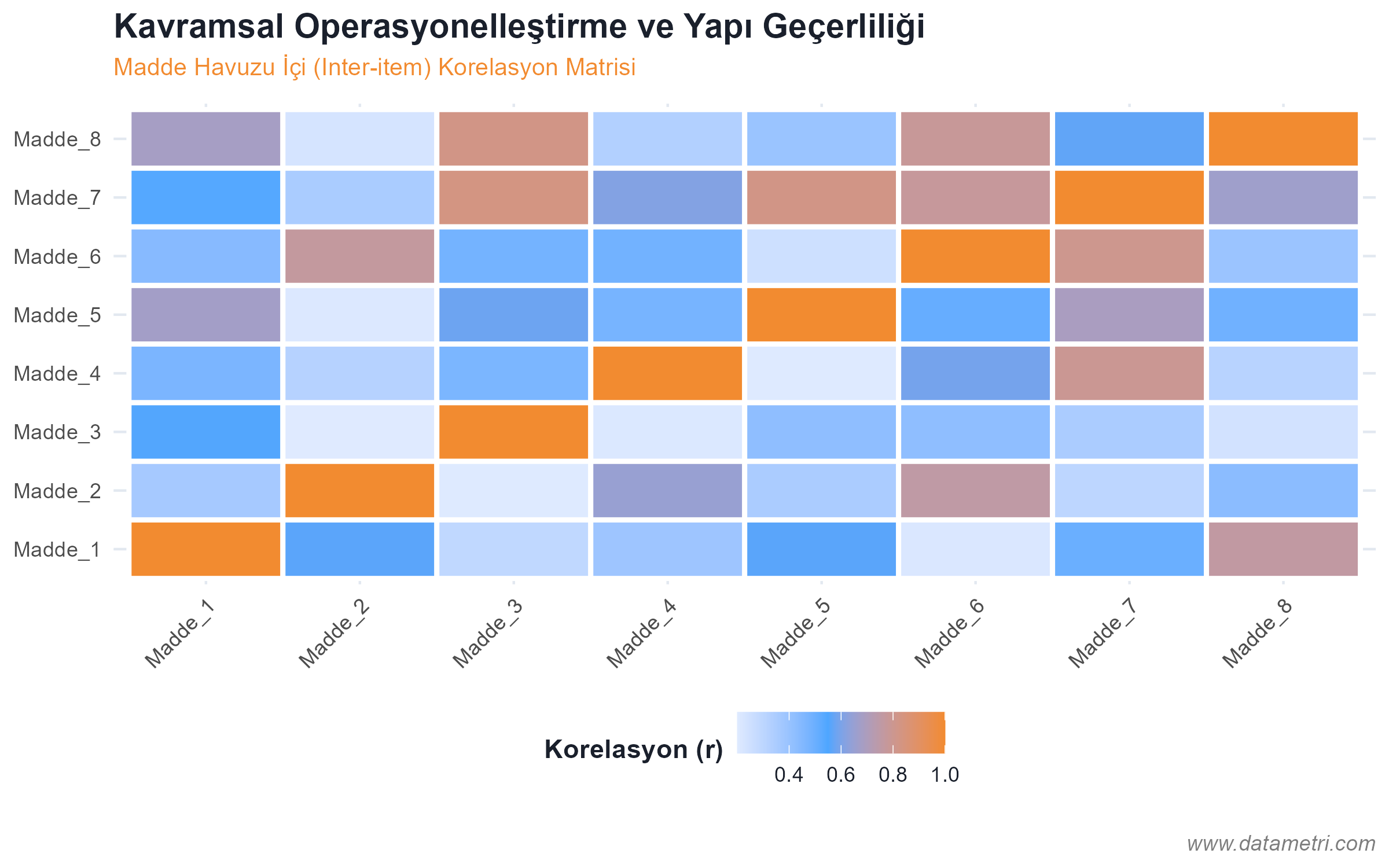
Conceptual Operationalization Matrix
caption = 'www.datametri.com'
We ensure that your questions are encoded with the same cognitive meaning by all demographic layers of the target audience, and we guarantee a priori that the collected data measures "what is truly intended to be measured" (Construct Validity).
02
Cognitive Load Management and Survey Architecture (Routing)
Cognitive Load Survey Architecture

A questionnaire is not a tool for informing or testing participants; it is a data collection instrument with neurological limits. According to Cognitive Load Theory, filling the form with overly complex grid (matrix) questions or unnecessary length leads to the dataset being contaminated with systematic noise.

Isolated Biases and Countermeasures
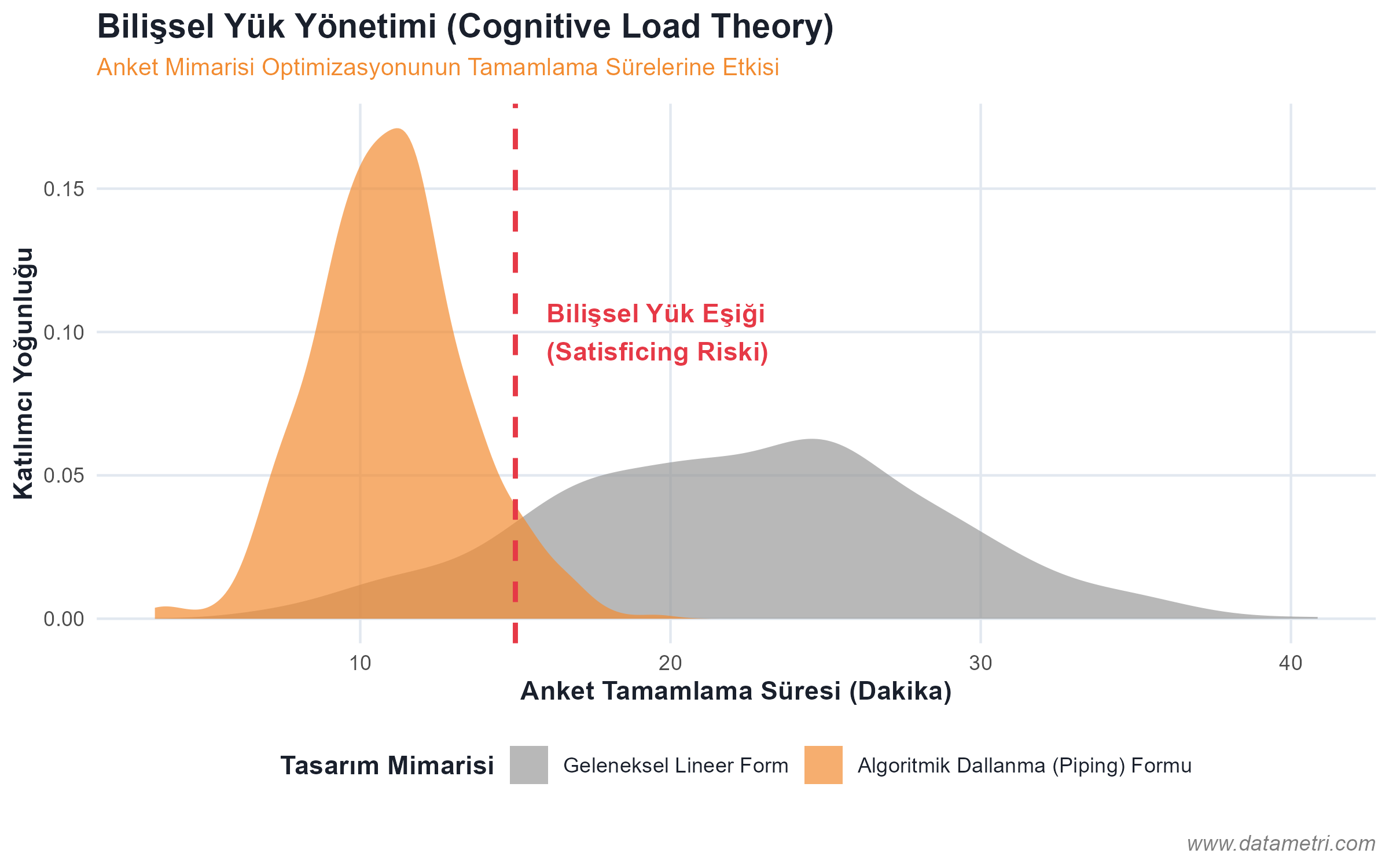
  • Satisficing and Survey Fatigue: To prevent the risk of the participant marking the same option repeatedly without reading the questions (straightlining) due to fatigue, we redesign the architecture of the survey and screen transitions.
  • Algorithmic Logic & Branching: Cognitive effort is minimized by constructing an algorithmic flow that ensures the participant only sees conditional sub-breakdowns (Piping) related to their own responses.
  • Order Bias: To prevent questions asked early on from manipulating later general perception questions, "Reversal" and "Block Randomization" procedures are applied between survey blocks.
Cognitive Load and Flow Optimization
caption = 'www.datametri.com'
While the optimization process dramatically reduces the survey drop-out rates, it brings the "Satisficing" variance in the data under statistical quality control.
03
Dimensionality Review and Pre-Test (Pilot Study) Engineering
Pilot Study Item Analysis

Before embarking on a large-scale and high-budget fieldwork, it is mandatory to subject the created questionnaire to a statistical "Crash Test (Pilot Study)" on a small and representative sample. Our goal at this stage is to mathematically detect and remove from the form weak questions that harm the measurement tool, do not produce variance (zero variance), or do not show internal consistency with other items.

Isolated Biases and Countermeasures
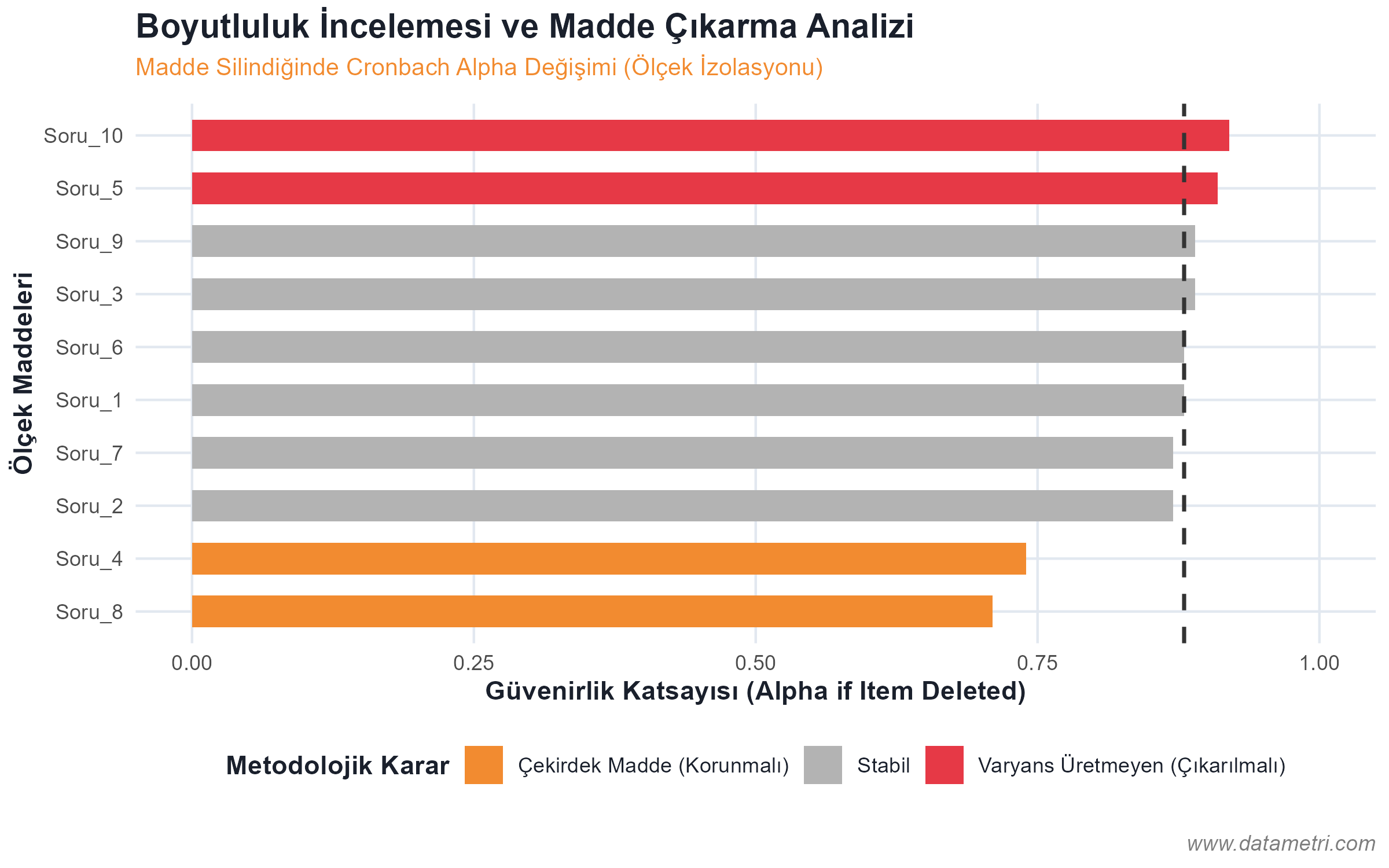
  • Internal Consistency Issues: By calculating Corrected Item-Total Correlation and "Cronbach's Alpha if Item Deleted" statistics over the pilot data, questions that lower measurement quality are identified.
  • Dimensionality Bias: We test whether the questions are clustered correctly empirically under the theoretically targeted sub-dimensions via Exploratory Factor Analysis (EFA), and cull out "cross-loading" items.
Pilot Test and Item Analysis
caption = 'www.datametri.com'
This consultancy step prevents measurement disasters you might encounter in the main field operation. It guarantees the ultimate statistical analyzability of the data by saving the survey from unnecessary length (Parsimony).
04
Cross-Cultural Adaptation and Measurement Invariance
Cross-Cultural MGCFA

Translating a global market research form or an internationally valid academic scale directly into another language (e.g., Turkish) does not mean that the scale will possess the same psychometric properties in the target population. Cultural adaptation is a strict methodological protocol beyond simple linguistic translation.

Isolated Biases and Countermeasures
  • Equivalence Bias: To preserve the reflections of the original scale's cultural codes in the target language, we conduct iterative translation procedures accompanied by Back-Translation and expert panel evaluations.
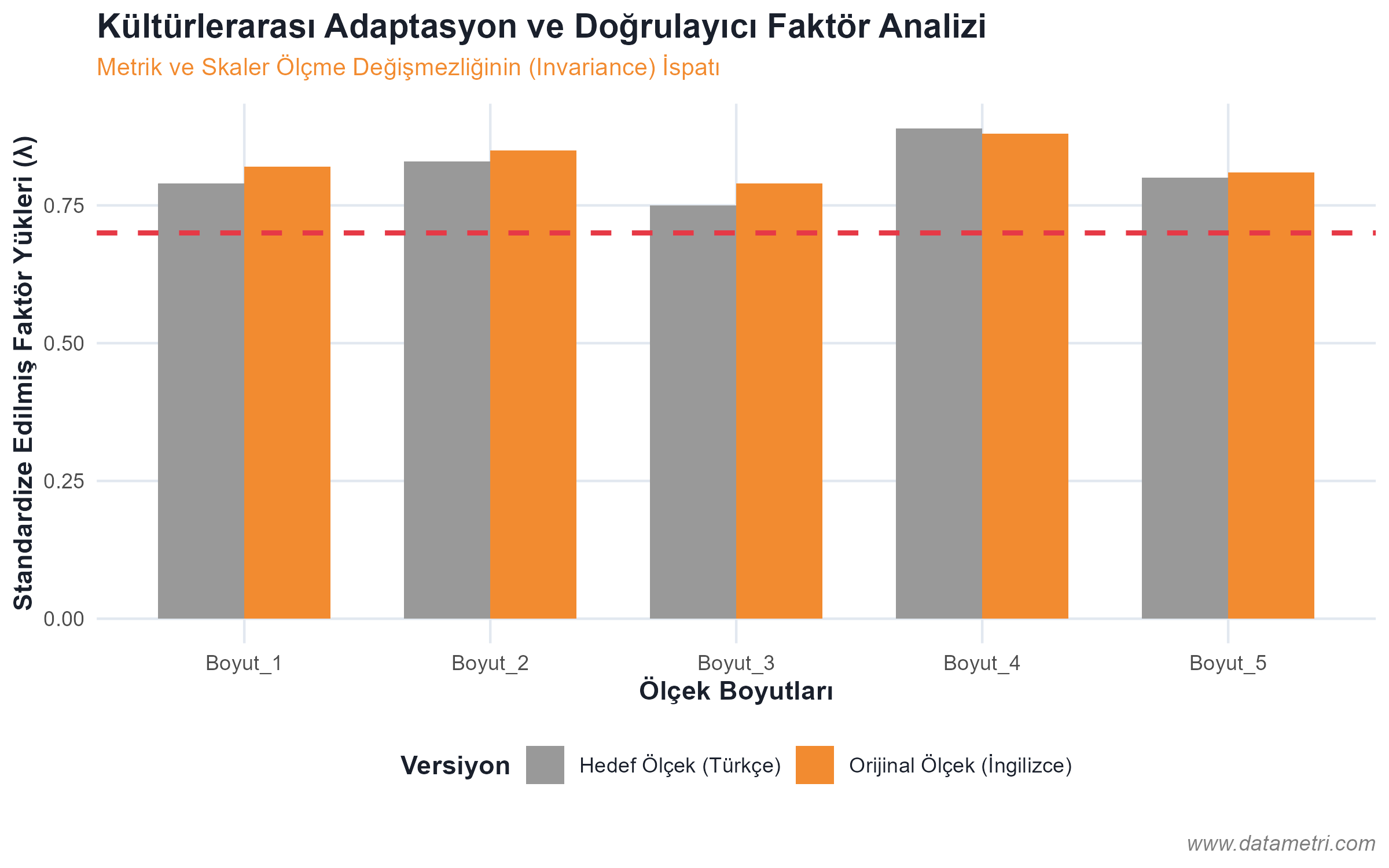
  • Invariance Failure: We mathematically prove whether the translated survey is perceived "with exactly the same weight" as in the original language via Confirmatory Factor Analysis (CFA); with Configural, Metric, and Scalar invariance tests.
Cultural Adaptation and Measurement Invariance
caption = 'www.datametri.com'
It is an indispensable step, especially for global performance scorecards of multinational corporations or international publications (Q1). It proves that data collected from different countries can be compared "Apples to Apples".
05
Response Formats and Acquiescence Bias Control
Format Design Response Bias

The measurement scales used in the questionnaire (e.g., 5-point Likert, Semantic Differential, MaxDiff) draw econometric boundaries that directly determine the participant's response variance. If the scale intervals are not designed to be conceptually equidistant, treating the obtained data as "Continuous Data" fundamentally violates parametric test assumptions.

Isolated Biases and Countermeasures
  • Acquiescence Bias: To break participants' tendency to constantly mark the "Agree" option regardless of the survey items' content; methodologically bipolar (reverse coded) questions are integrated into the item pool.
  • Central Tendency Bias: To prevent indecisive participants from constantly taking refuge in the "Undecided" option, scales are adapted to a forced-choice, even-numbered (e.g., 4-point or 6-point) format.
The comprehensiveness of the scales to be used and the balance of the option intervals is the "Statistical Calibration" stage that determines whether the data can be analyzed in later stages in accordance with Polychoric (WLSMV) or Pearson correlations.

Let's Optimize Your Questionnaire Together

Contact us to test the psychometric power of your scale and align it with international standards (APA) before you start collecting data.