Datametri Logo
01
Reporting & Decision Support System — Report Panel
MindBoard · Descriptive Analytics PredictiveMind · ML Forecasting SimulationMind · Causal AI

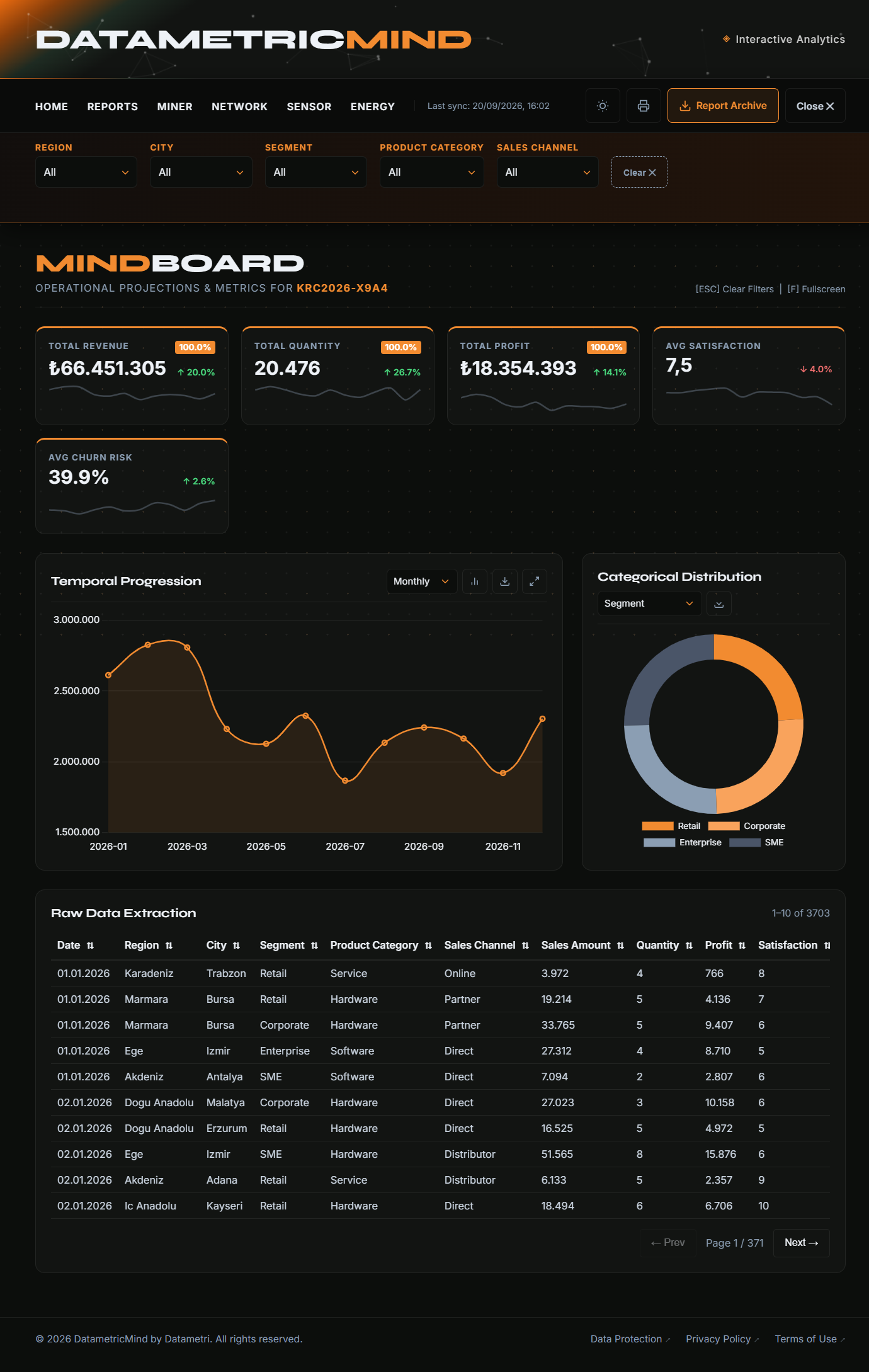
The Report Panel is a three-layer analytics infrastructure that converts your organisation's historical performance into meaningful KPI indicators, forecasts future revenue trends using machine-learning models, and models the revenue impact of operational decisions through causal simulations.

Which business need does this module address?
  • Your sales, operations and customer data are scattered across different systems (ERP, CRM), making it difficult to obtain a unified view of performance.
  • Revenue projections are based on historical averages; you require algorithmic forecasts that account for market dynamics.
  • The causal relationship between customer satisfaction or churn rate and revenue cannot be quantified, leaving investment decisions at an intuitive level.
MindBoard — Descriptive Analytics
  • Interconnected filters: Region, segment, product, sales channel — any selection instantly propagates across all charts and tables.
  • KPI sparklines: A monthly trend curve beneath each indicator card highlights deviations at a glance.
  • Data table: Filtered raw data accessible with column sorting, pagination and CSV export.
PredictiveMind — Revenue Forecasting
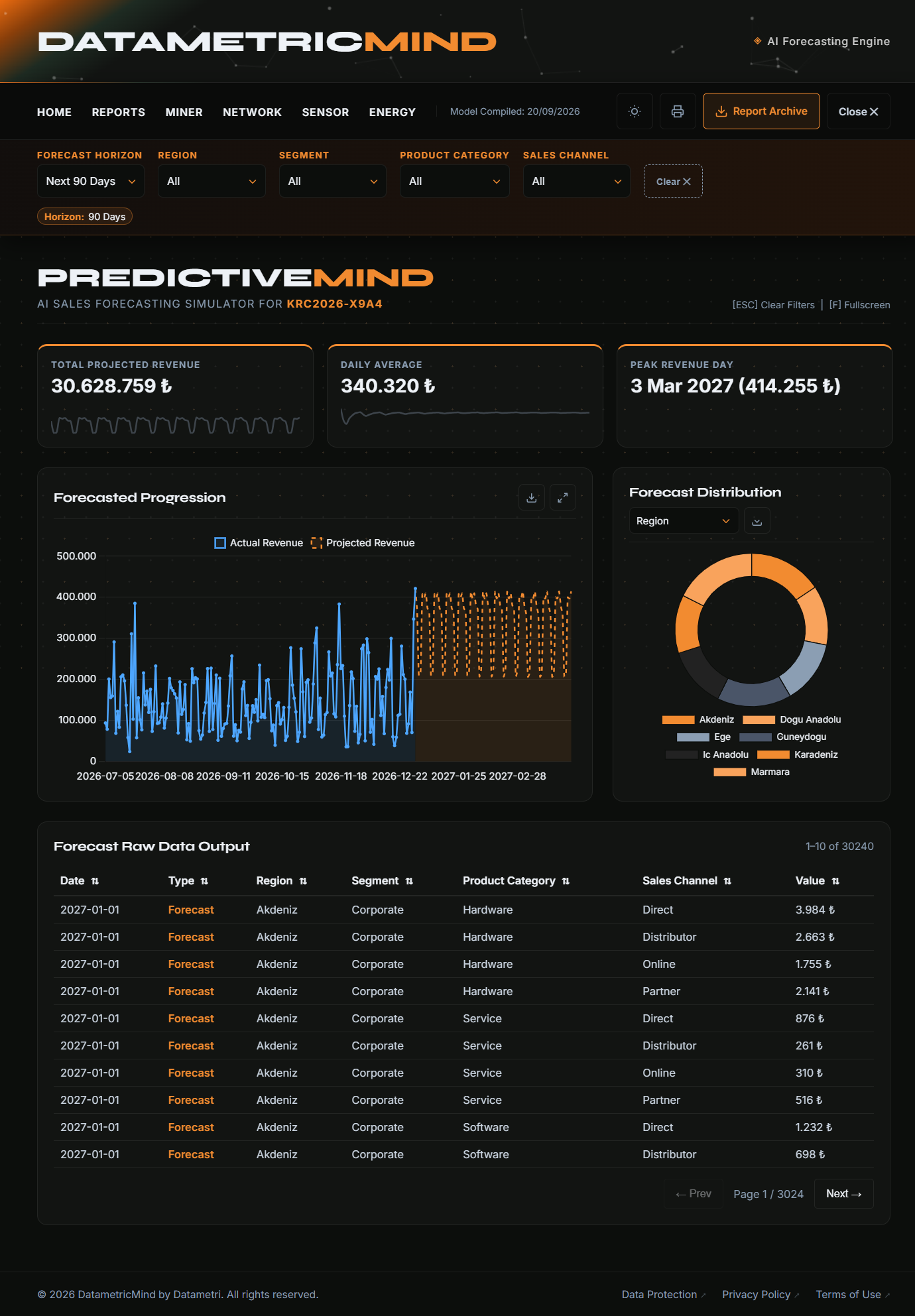
  • Random Forest model: R-trained engine with 30 / 90 / 180-day forecast horizons.
  • Actuals vs forecast comparison: Side-by-side monitoring on a single chart.
  • Peak day detection: Automatic highlighting of the date with the highest projected revenue.
SimulationMind — Causal Simulation
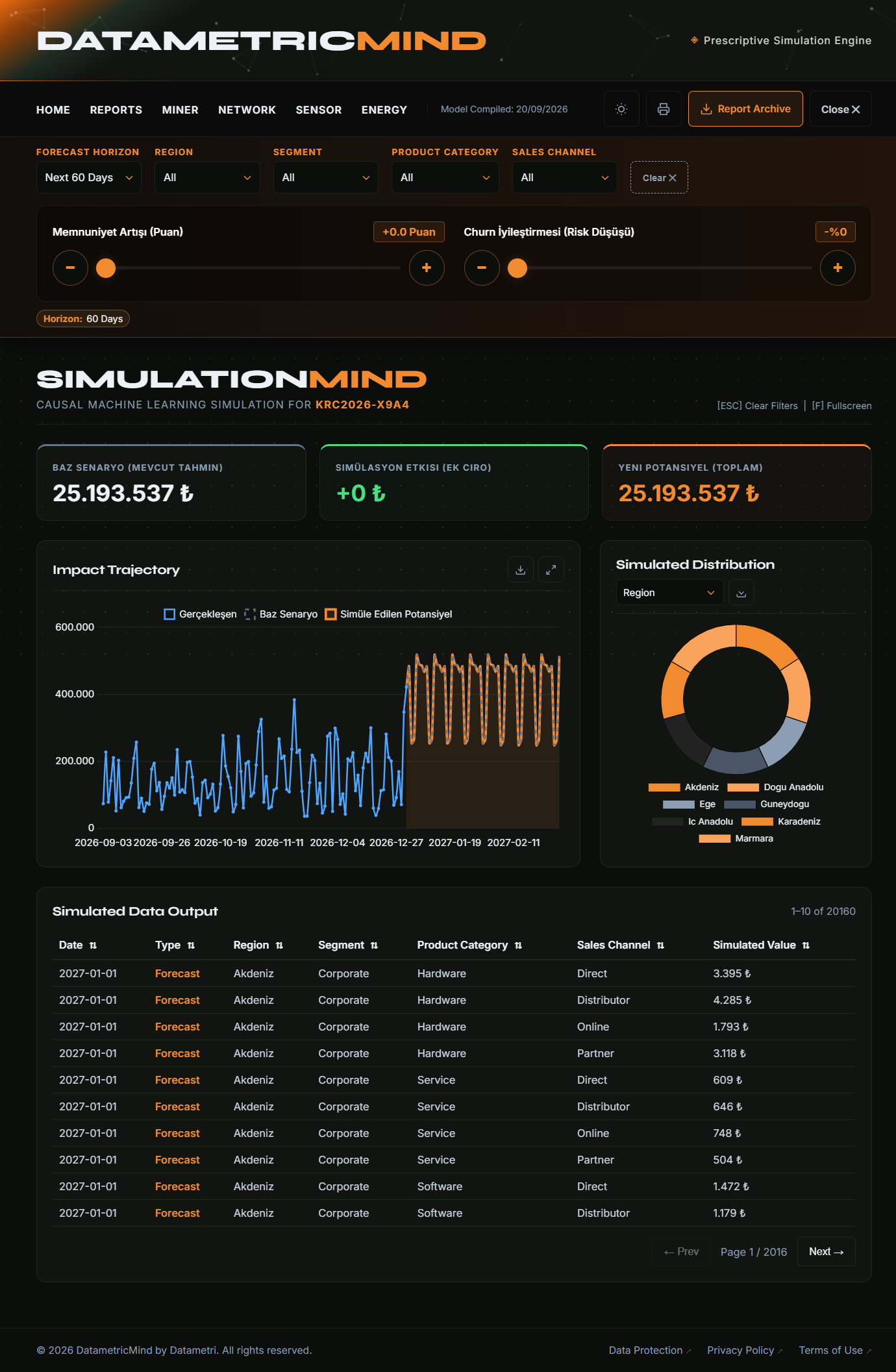
  • Two slider controls: Customer satisfaction improvement (+0–3 pts) and churn reduction (0–50%) produce real-time cumulative impact calculations.
  • Three KPI outputs: Base scenario / simulation effect / new revenue potential.
  • Client-specific coefficients: Elasticity parameters computed from historical data.
ModuleAnalytics Layer
MindBoardDescriptive — What happened?
PredictiveMindPredictive — What will happen?
SimulationMindPrescriptive — What should I do?
Filter Breadth
  • Region · City · Segment · Product Category · Sales Channel
  • Chart mode toggle (bar ↔ line)
  • Full-screen mode and PNG export
  • [ESC] shortcut to reset all filters
Business value: While the sales team monitors historical performance, the finance division automatically receives a 6-month revenue projection; senior management simultaneously views the measurable revenue impact of customer-experience investments through scenario tables — all delivered in real time through a single secure portal.
02
Qualitative Text Analysis & NLP Processing
Text Miner · Automated Coding MinerMind · Semantic Visualisation CommentsMind · Product Review Intelligence

Open-ended survey responses, customer complaints, focus-group transcripts and social-media comments are qualitative data sources carrying high insight potential that typically go unprocessed. This platform transforms such data into actionable organisational intelligence through AI-assisted automated coding and advanced visualisation techniques.

Which business need does this module address?
  • Manually coding thousands of open-ended responses takes weeks, resulting in inefficient use of analyst resources and analysis timelines.
  • The root causes of customer dissatisfaction cannot be systematically identified, and recurring complaint patterns remain invisible.
  • The causal link between specific product features or service attributes and overall satisfaction scores cannot be established.
  • Competitor product reviews across e-commerce platforms cannot be analysed systematically, making it impossible to benchmark your own product's customer perception against rivals.
Text Miner — Automated Coding Engine
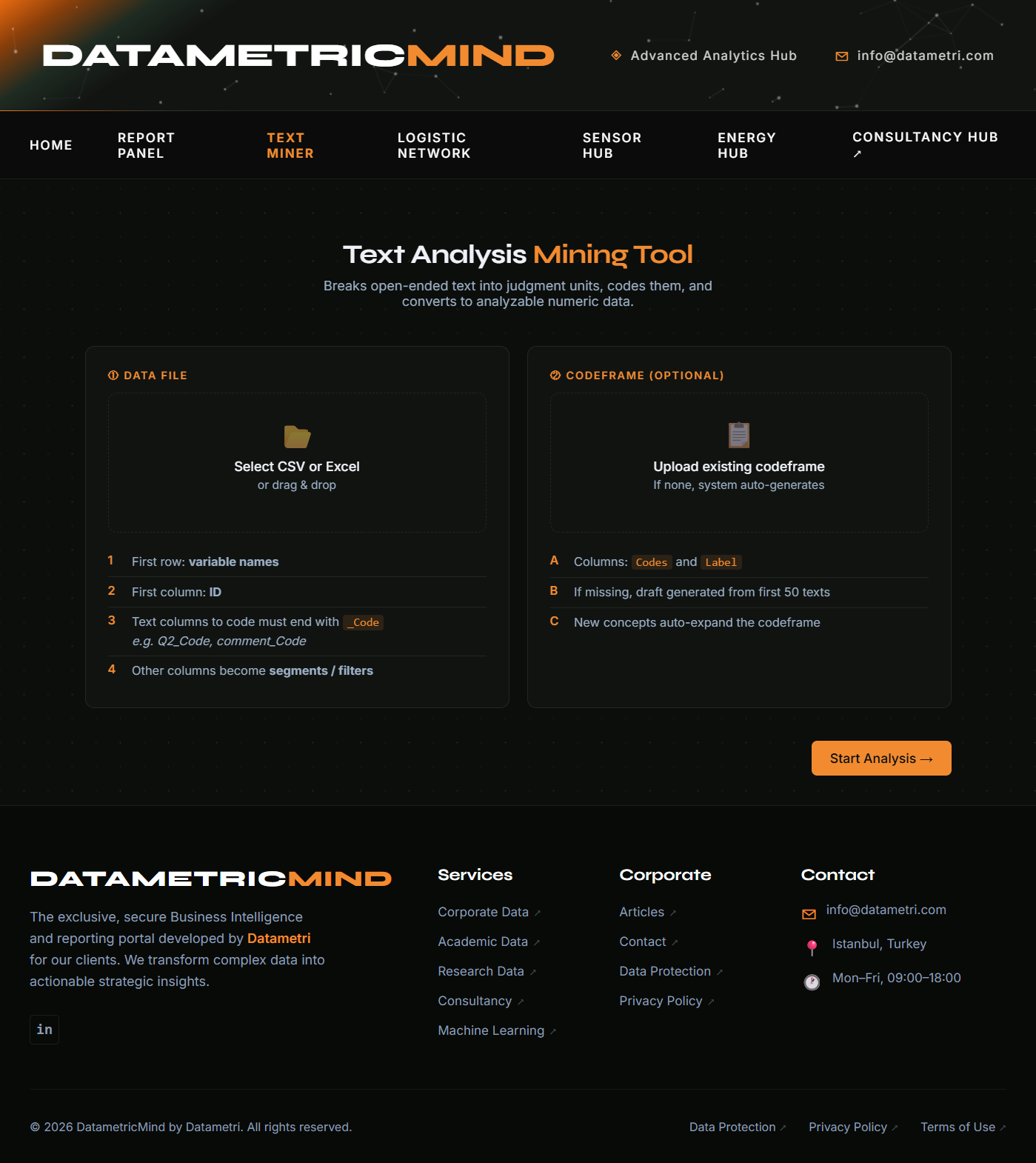
  • CSV/Excel upload: The first 50 responses are analysed and an automated codeframe is constructed.
  • AI-driven coding: All responses are classified against the codeframe in the cloud (Render.com API) within seconds.
  • Enterprise outputs: Frequency table, Excel and CSV download, persistent Firebase record.
MinerMind — Semantic Analytics Platform
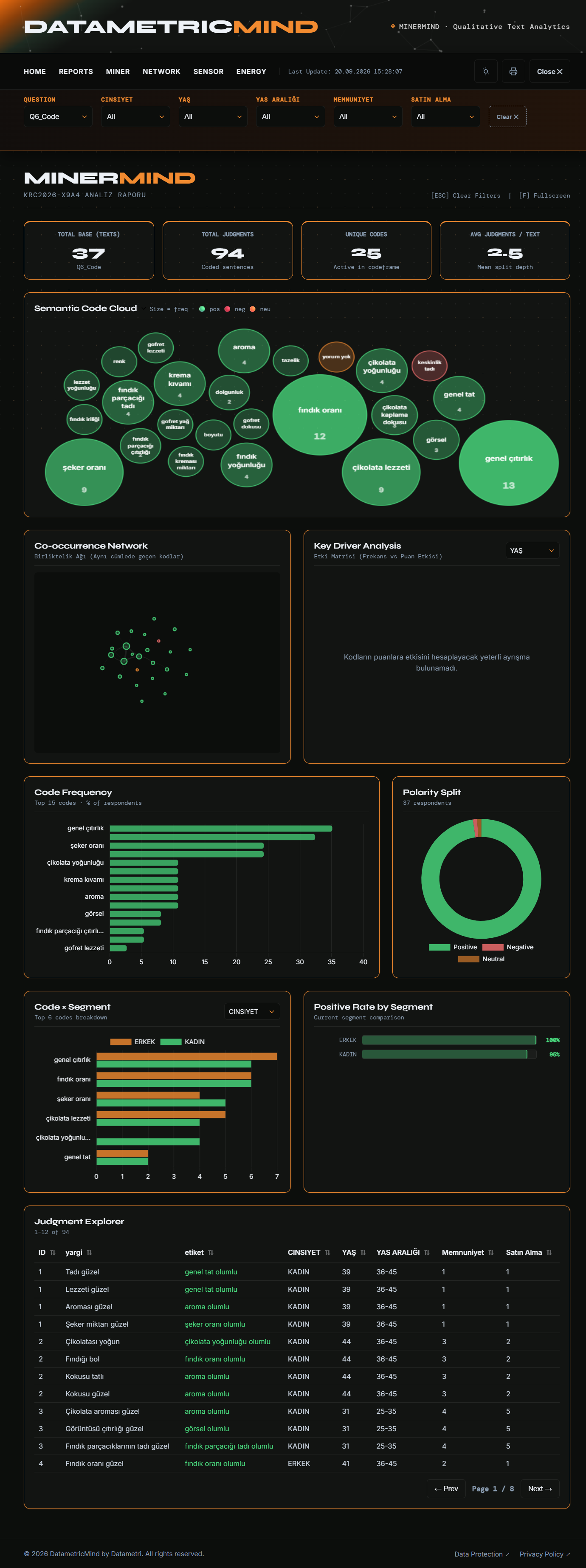
  • Semantic code cloud: Force-directed visualisation scaled by code frequency, with polarity colour-coding (positive / negative / neutral).
  • Co-occurrence network: Relationship graph for codes appearing together within the same sentence — edge thickness reflects co-occurrence count.
  • Key driver matrix: Frequency × impact scatter plot — four-quadrant priority map.
  • Segment comparison: Code distribution compared across any demographic or behavioural segment variable.
CommentsMind — Product Review Intelligence
  • Chrome extension data collection: Automatically scrapes product reviews — including competitor listings — from Trendyol, Hepsiburada, N11 and Çiçeksepeti into a single CSV. One tool, four platforms.
  • TextMiner integration: Collected reviews are passed to TextMiner; each sentence is automatically parsed into semantic themes such as "Delivery Speed positive" or "Assembly Difficulty negative". No manual tagging required.
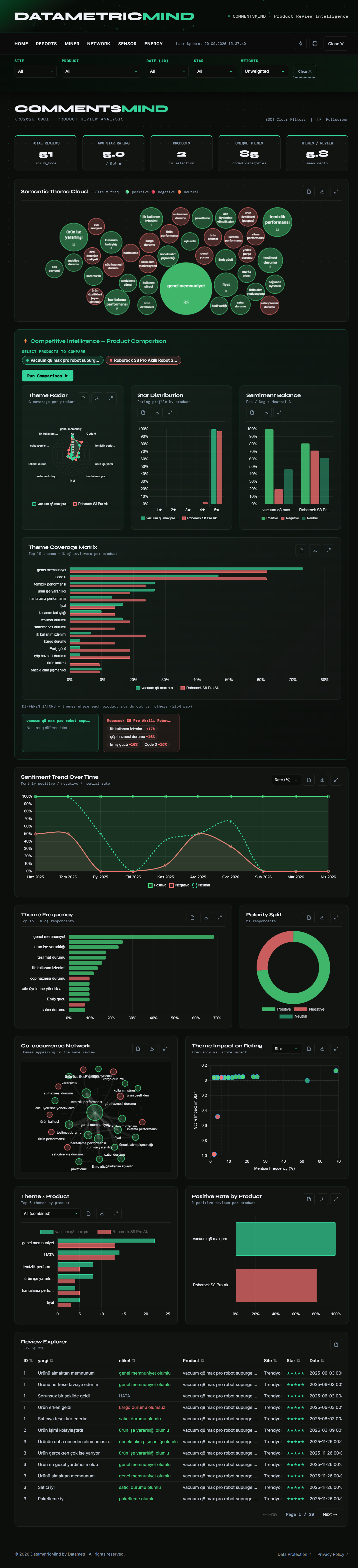
  • Competitive Intelligence Panel: Side-by-side comparison of up to five products via Theme Radar, Star Distribution, Sentiment Balance, Theme Coverage Matrix and automatic Differentiator detection (themes with a ≥15 % gap vs. competitors).
  • T2B / B2B Filter: Analyse the thematic profiles of satisfied (4–5 star) and dissatisfied (1–2 star) customer segments independently, then compare them.
  • Sentiment Trend: Monthly positive / negative / neutral theme trend — measure the impact of product updates or campaigns over time.
  • Theme Impact on Rating: Which themes lift the star rating, which drag it down? A priority matrix ranks actionable areas by frequency and rating effect.
  • Like-weighted analysis: A review with 49 likes represents 50 voices. All percentages and averages are recalculated accordingly — weight = likes + 1.
Visualisation Repertoire
  • Semantic code cloud (force-directed)
  • Word cloud (Turkish stop-word filtered)
  • Co-occurrence network (vis.js)
  • Key driver analysis (scatter)
  • Code frequency chart (horizontal bar)
  • Segment comparison (stacked bar)
  • Polarity doughnut (positive / negative / neutral)
  • Judgment explorer table
CommentsMind — 10 Analysis Components
ComponentOutput
Semantic Theme CloudFrequency × polarity visual map
Theme Radar10-axis product comparison
Star DistributionStar-rating profile benchmark
Sentiment BalancePositive / negative / neutral %
Theme Coverage Matrix15 themes × product coverage
Sentiment TrendMonthly sentiment time series
Theme FrequencyTop 15 themes by reach (%
Co-occurrence NetworkTheme relationship graph
Theme Impact on RatingStar-effect priority matrix
Review ExplorerCoded judgment table + CSV
Business value: Clients conducting open-ended survey analyses report reducing processing time by up to 80% compared with traditional manual coding, while systematically uncovering qualitative patterns that previously went undetected. With CommentsMind, brand managers can obtain a competitor-benchmarked thematic profile, T2B/B2B segment breakdown and monthly sentiment trend within hours — shaping product development priorities with evidence-based insights rather than intuition.
03
Logistics Network Optimisation & Urban Mobility Analysis
NetworkMind · CPM/PERT · Dijkstra · Monte Carlo MobilityMind · OD Flow · Stated Preference

This platform serves logistics operators seeking to identify bottlenecks in corporate distribution networks and optimise route planning, as well as municipalities and transport consultancies needing to model urban travel patterns.

Which business need does this module address?
  • You cannot determine which route, at which time of day, creates a bottleneck in your distribution network — leaving you reacting to peak-hour delays rather than preventing them.
  • The cumulative impact of potential disruptions on delivery times cannot be projected, keeping risk management at an intuitive level.
  • Origin–destination (O-D) flows in urban transport research cannot be visualised, and the effect of congestion charges on modal split cannot be modelled numerically.
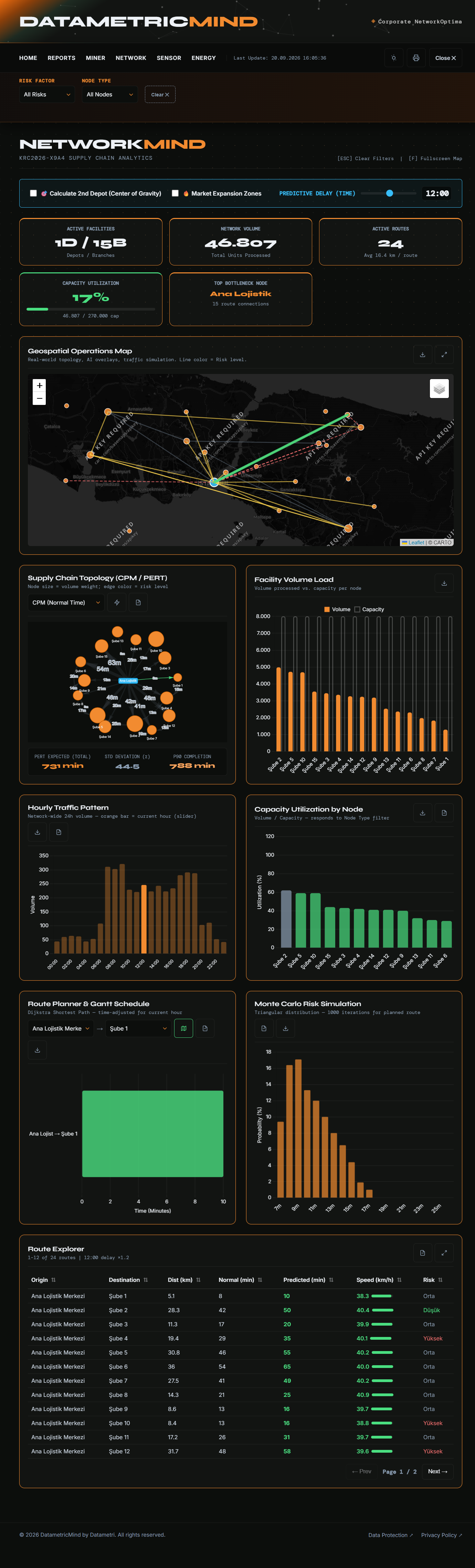
NetworkMind — Logistics Network Analysis
  • Geographic map (Leaflet.js): Warehouses and branches on real coordinates; route colour reflects risk level.
  • CPM/PERT topology network: Normal duration / expected duration toggle; critical path automatically highlighted.
  • Dijkstra route planner: Shortest-path calculation with peak-hour multiplier applied by selected time slot; Gantt chart output.
  • Monte Carlo simulation: 1,000 iterations, triangular distribution; P90 completion time and probability histogram.
  • AI layers: Weighted centre-of-gravity optimisation (second warehouse location) and market expansion heat map.
MobilityMind — Urban Mobility Analysis
  • O-D flow map: District-level polyline visualisation — line thickness represents journey volume.
  • Congestion charge simulator: SP-data-driven modal shift forecast for a 0–150 TRY charge range.
  • CO₂ emission comparison: Greenhouse-gas impact per journey by mode.
  • Value of Time (VOT) analysis: Passenger speed–price preference trade-off.
MethodOutput
DijkstraShortest path + peak-hour delay
CPM/PERTCritical path + expected duration σ
Monte CarloP90 completion + risk histogram
O-D MatrixDistrict-level flow intensity
SP AnalysisModal shift forecast
Business value: Logistics clients report improving delivery times by an average of 15–25% through bottleneck identification, while Monte Carlo risk analysis enables realistic SLA commitments for critical deliveries. In urban mobility projects, the impact of congestion policies on modal split is pre-tested through simulation before fieldwork begins.
04
IoT Sensor Intelligence — Six-Domain Analytics Modules
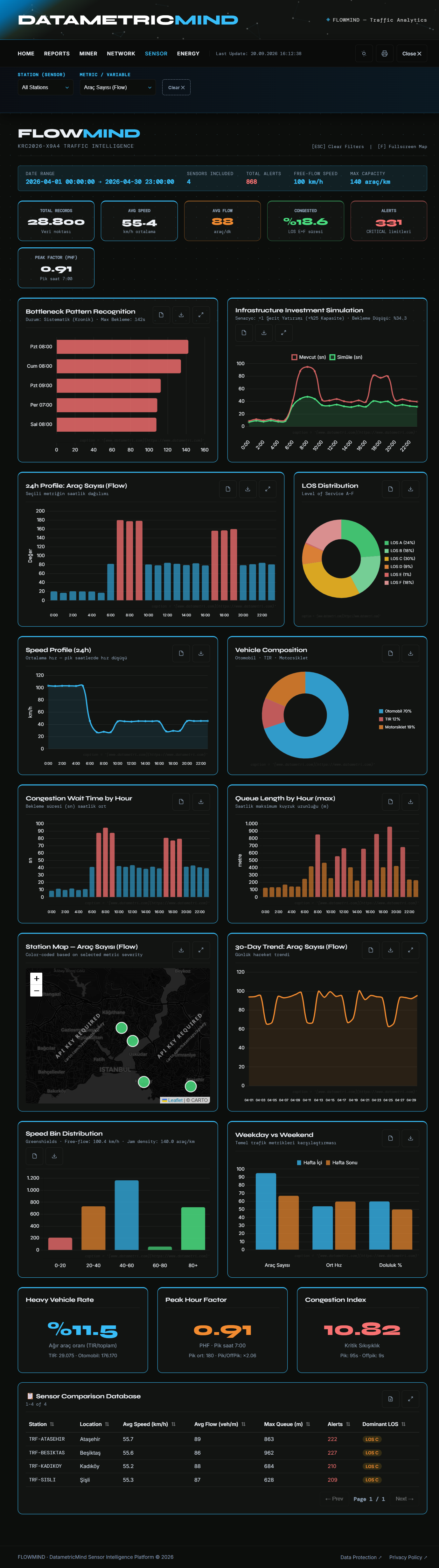
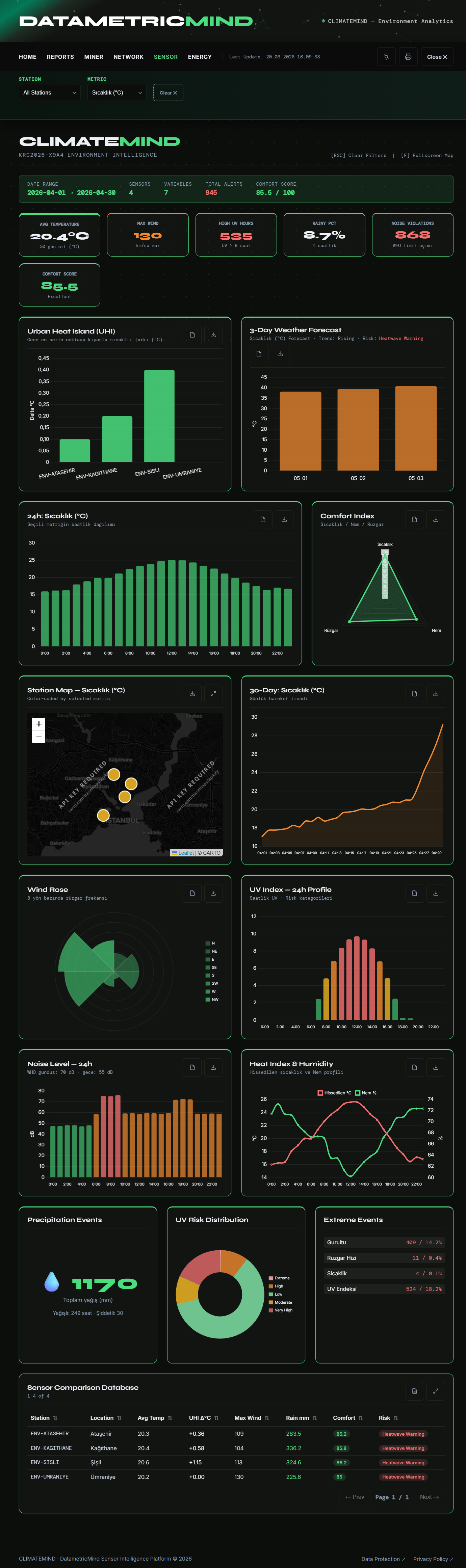
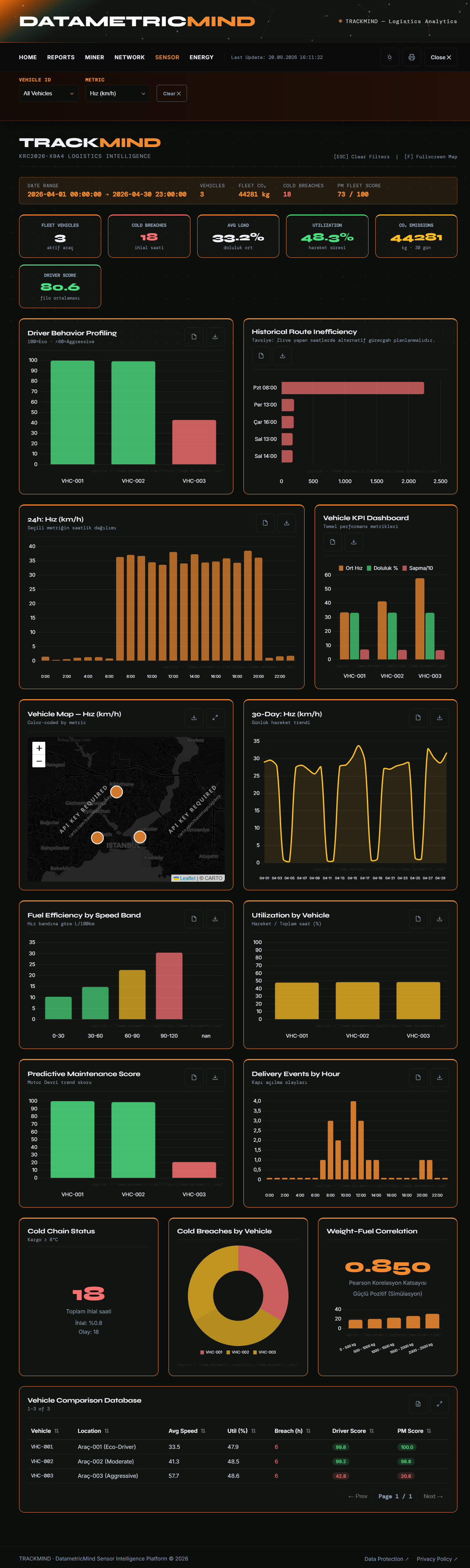
Traffic · Climate · Logistics GPS Air Quality · Urban Infrastructure · Industrial

Raw IoT data collected from sensor networks generates no value on its own. This platform processes real-time Firebase streams for six distinct operational domains against industry-specific analytical models and standards (WHO 2021, EPA AQI, ISO 10816, OEE), delivering actionable insights to decision-makers.

Which business need does this module address?
  • Data is flowing from your traffic, air-quality or machinery sensors, but how to translate that data into strategic decisions remains unclear.
  • Machine failures generate reactive maintenance costs; downtime cannot be anticipated through predictive maintenance.
  • Environmental data (noise, air quality, temperature) cannot be reported in comparison against international standards (WHO, EPA).
Summary of Six Analytics Modules
  • FlowMind — Traffic: LOS (Level of Service A–F), bottleneck identification, PHF calculation, investment simulation, Greenshields speed-density model.
  • ClimateMind — Environment: Urban Heat Island map, WHO 2021 comparative noise analysis, Wind Rose, 3-day forecast, UV index profile.
  • TrackMind — Logistics GPS: Cold-chain violation monitoring, driver behaviour scoring (Eco / Moderate / Aggressive), predictive maintenance score.
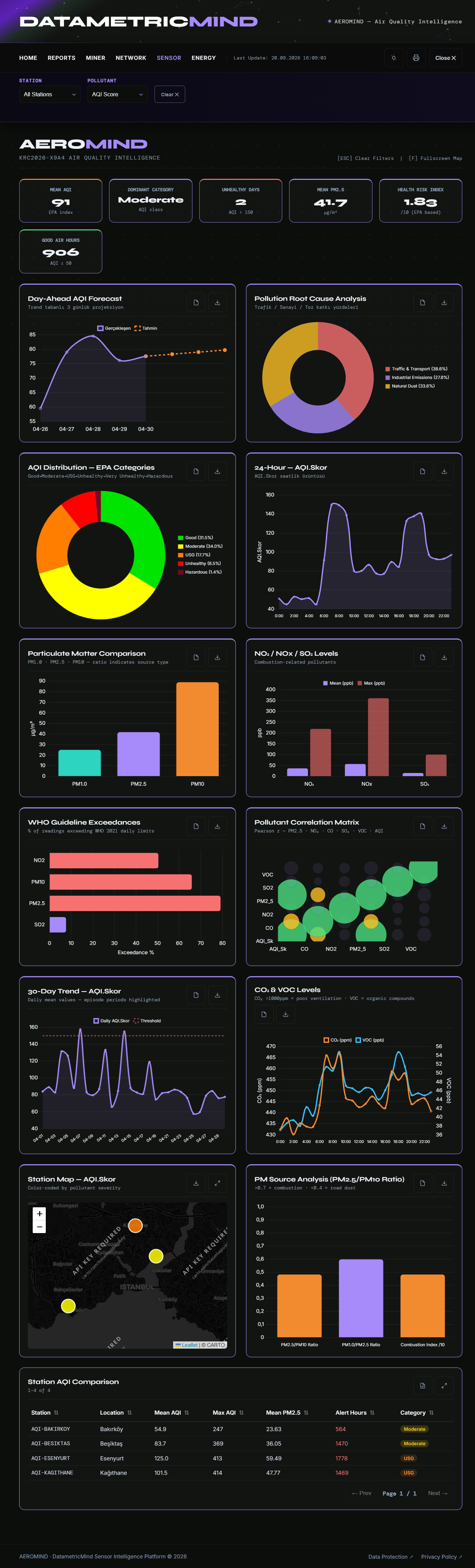
  • AeroMind — Air Quality: PM2.5 / PM10 / NO₂ / AQI — EPA categorisation, pollutant source apportionment, WHO exceedance percentage.
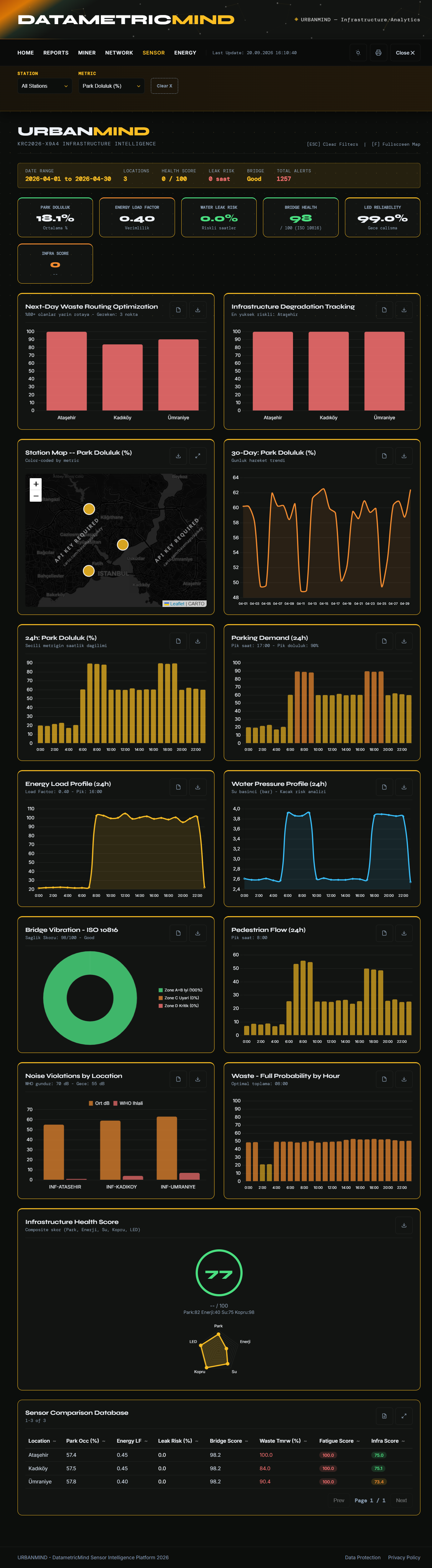
  • UrbanMind — Urban Infrastructure: CEWS early-warning system, bridge vibration ISO 10816 classification, water leak risk analysis, waste-collection route forecasting.
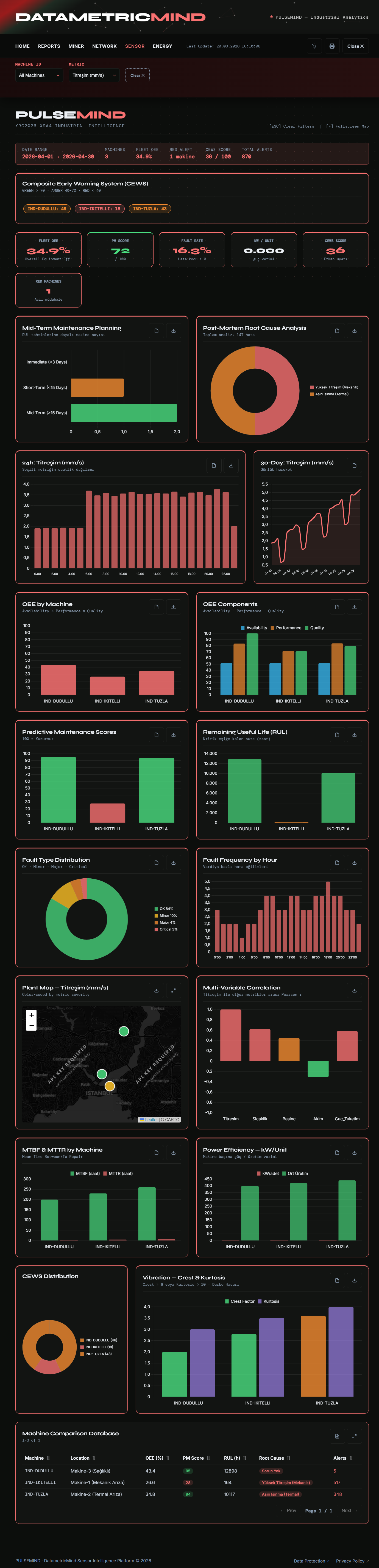
  • PulseMind — Industrial: OEE (Availability × Performance × Quality), MTBF / MTTR, RUL (Remaining Useful Life), root-cause analysis.
ModuleKey Standard / Metric
FlowMindLOS A–F · Greenshields · PHF
ClimateMindWHO 2021 · UHI · Wind Rose
TrackMindCold Chain · PM Score
AeroMindEPA AQI · WHO PM Ratio
UrbanMindISO 10816 · CEWS · Leak Risk
PulseMindOEE · MTBF · RUL · Kurtosis
Real-Time Data Infrastructure
  • Firebase Sensor DB — live data stream
  • Leaflet.js geographic map integration
  • Client-specific sensor-type detection (meta.sensor_types)
  • Only authorised modules are displayed to the user
Business value: Industrial clients using PulseMind's RUL (Remaining Useful Life) module report 30–40% reductions in unplanned machine downtime. Municipalities using UrbanMind can direct water-network maintenance teams to high-leak-risk zones in real time based on actual pressure sensor data.
05
CBAM Carbon Compliance & Energy Emission Management — EnergyMind
Reg.(EU) 2023/956 · CBAM Annex IV Communication Template Registry XML Generation

The EU Carbon Border Adjustment Mechanism (CBAM) entered its definitive phase in 2026. Turkish facilities exporting steel, aluminium, cement, fertiliser or hydrogen to the EU are legally required to calculate the embedded emissions in their products under Annex IV methodology, document the results, and communicate them to their EU importers. The first annual declaration deadline is 30 September 2027.

Which business need does this module address?
  • We do not know how to calculate our facility's emissions in compliance with EU Annex IV methodology; unverified calculations expose us to a €100/tCO₂e penalty risk (Art. 26).
  • Our EU importers have started requesting the Communication Template PDF, and we are unable to generate this document using our existing systems.
  • We cannot monitor supplier emission-factor data quality (the 80/20 rule), nor can we visualise which procurement decisions drive our CBAM liability.
EnergyMind Deliverables
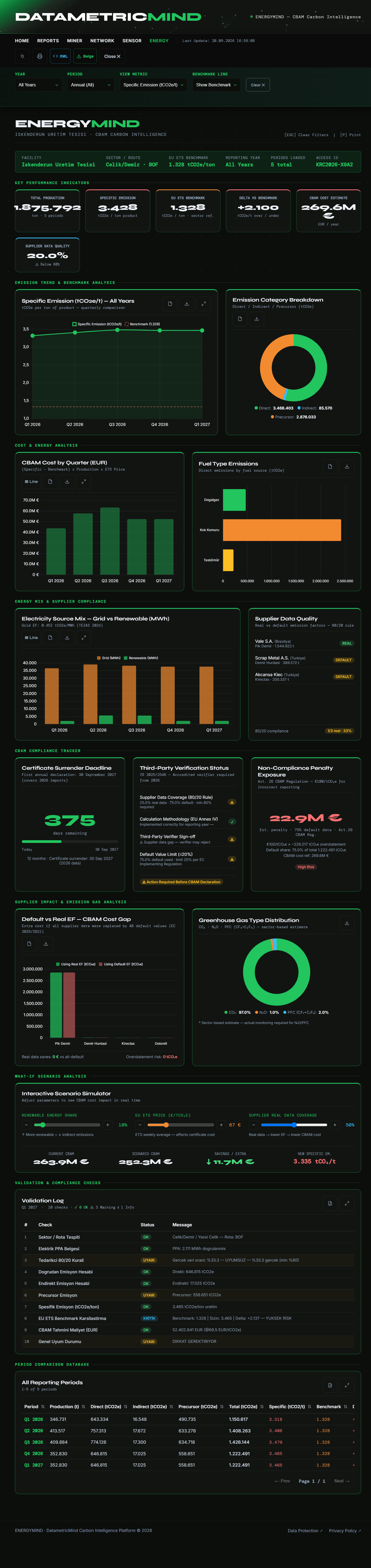
  • Emission calculation: Direct (Scope 1, IPCC 2006 EF) + Indirect (Scope 2, TEIAS 2024: 0.452 tCO₂e/MWh) + precursor embedded emissions; 80/20 supplier data-quality audit.
  • Communication Template PDF: 9-section official format compliant with EU Annex IV (Parts A–I), ready for signature; can be forwarded directly to the EU importer.
  • CBAM Registry XML: Registry-ready XML — once the EU importer adds their EORI number and uploads the file, a draft declaration is generated automatically.
  • CBAM Compliance Tracker: Countdown to the 30 September 2027 certificate surrender deadline, accredited-verification readiness status, penalty exposure calculation.
  • Scenario Simulator: Real-time modelling of the CBAM cost impact of changes to renewable energy share, ETS price and supplier data coverage.
Covered Sectors & EU ETS Benchmarks
Sector / RouteBenchmark
Steel — BOF1.328 tCO₂e/t
Steel — EAF0.283 tCO₂e/t
Primary Aluminium1.584 tCO₂e/t
Cement Clinker0.766 tCO₂e/t
Fertiliser / Ammonia1.694 tCO₂e/t
Process & Delivery
  • Excel template → R calculation → secure web access
  • Dashboard access ready within 5-6 business days
  • Single update cycle per quarter
  • Regulations: IR (EU) 2023/1773 · IR (EU) 2025/2547 · Art.26: €100/tCO₂e
Business value: Given that Turkey currently has no ETS equivalent, Turkish exporters bear the full CBAM cost. A verified, properly documented declaration both eliminates penalty risk and reduces the EU importer's certificate liability — directly strengthening your competitive position. Suppliers who fail to provide data or provide inaccurate data risk being de-listed by EU importers.
06
Secure Mobile Access — Progressive Web App (PWA) Portal
iOS & Android Installation Session Management · Service Worker

The DatametricMind portal is backed by Progressive Web App (PWA) technology, providing secure, instant mobile access to all analytics modules listed above. It can be installed on iOS and Android devices without an app store intermediary; all authorised modules are automatically listed with a single client code.

Which business need does this module address?
  • Managers and field teams cannot access current analytics when away from the office, slowing down decision-making.
  • Being required to manage multiple URLs and passwords for different modules compromises both usability and security.
  • The analytics platform needs to be accessible on iOS and Android without incurring separate mobile-application development costs.
Key PWA Portal Features
  • Single entry point: On entering the client code, the system automatically detects and lists all authorised modules (Analytics Engines, Carbon Intelligence, Sensor Intelligence) as cards.
  • Secure session management: 30-second warning and automatic log-out after 15 minutes of inactivity.
  • iOS installation: Safari → Share → Add to Home Screen; Android: Chrome → Install App.
  • Service Worker: Offline support, automatic update detection and instant activation via SKIP_WAITING.
  • All modules fully responsive: Sensor charts, CBAM dashboard and NLP analyses are all optimised for mobile viewports.
Module Access Categories
  • Analytics Engines: MindBoard · PredictiveMind · SimulationMind · MinerMind · NetworkMind · MobilityMind
  • Carbon Intelligence: EnergyMind
  • Sensor Intelligence: FlowMind · ClimateMind · TrackMind · AeroMind · UrbanMind · PulseMind
Security Architecture
  • Client code → file/job detection → module list (zero-knowledge routing)
  • All pages closed to search engines (noindex/noarchive)
  • sessionStorage-based source tracking
  • EnergyMind: Data/{JOB_ID}/annual.js HEAD check for auto-detection
Business value: Senior executives can access current KPI indicators, sensor alerts and CBAM compliance status from their smartphones during site visits, board meetings or client engagements. Multiple password management is eliminated; the entire analytics platform is accessed through a single, secure entry point.
07
CSRD Sustainability Reporting Intelligence — SustainMind
ESRS · CSRD (EU 2022/2464) · EU Taxonomy Double Materiality · GOV Declaration · SBM-1 iXBRL / ESEF · 10+ Page Sustainability Statement

SustainMind is a digital CSRD intelligence platform providing end-to-end support for companies subject to the EU Corporate Sustainability Reporting Directive. From double materiality assessment and client-specific ESRS data collection to GHG calculation, a 10+ page English sustainability statement and iXBRL tagging — the entire workflow runs within a single platform.

Which business need does this module address?
  • We do not know which ESRS standards apply to us; do we need to complete all 93 data points? How do we carry out the materiality assessment?
  • Producing an English CSRD statement — with ESRS references, governance disclosures (GOV-1 to GOV-5) and signature pages — from scratch takes months.
  • EU importers, financiers or investors are requesting sustainability reporting; we are unsure how to handle iXBRL tagging and EU Taxonomy disclosures.
  • We need assurance that our GHG calculation is verified and standards-compliant at Scope 1/2/3 level.
Double Materiality Assessment
  • EFRAG IG 1 methodology: Both impact (inside-out) and financial (outside-in) materiality scoring across 10 ESRS standards (E1–E5, S1–S4, G1).
  • Automatic classification: High / Mid / No — the client-specific Excel form is automatically filtered; 60–85 relevant data points rather than the full 93.
  • TR/EN PDF report: IRO time horizons, policy declarations, SBM-1 business model, GOV-1 to GOV-5 declaration and EU Taxonomy summary included.
CSRD Dashboard & Analytics Modules
  • GHG calculation engine: Scope 1/2/3, source-level emission breakdown, energy mix, renewable share, intensity (tCO₂e/M€), year-on-year trend.
  • Environment (E2–E5): Pollution, water, biodiversity, waste — visualisations and year-on-year comparison.
  • Social (S1–S4): Headcount, diversity, pay gap, occupational safety, supply chain.
  • Governance (G1 + GOV): Business conduct KPIs, governance maturity profile (0–10), climate risk estimate (E1-9), taxonomy KPI cards.
  • Scenario simulator: Real-time modelling of GHG and cost impact from changes to renewable energy share and efficiency levels.
  • Validation log: 12 automated ESRS checks — OK / WARNING / CRITICAL; CSV output for assurance providers.
Automated Output Documents
  • 10+ page CSRD Sustainability Statement: English; ESRS 2 General Disclosures → E1–G1 → Appendix A (full 93-point data table) → Appendix B (assurance + signature pages).
  • iXBRL / ESEF file: EFRAG ESRS Set 1 draft taxonomy — 30+ XBRL tags covering GHG, S1, G1, taxonomy rates and policy declarations.
  • Filtered Excel form: 6-tab workbook including Policy Declarations, Action Plans (CapEx/OpEx), EU Taxonomy and GOV Declaration sheets.
Module / ComponentCoverage
Pre-Assessment6-step wizard + TR/EN PDF report
Materiality10 ESRS standards, EFRAG IG 1 compliant
GOV DeclarationGOV-1 to GOV-5 + maturity score (0–10)
SBM-1Business model, VC position, geographic scope
EU TaxonomyRevenue / CapEx / OpEx alignment rates
GHG EngineScope 1/2/3, source breakdown, intensity
CSRD Statement10+ pages, English, signature pages
iXBRL / ESEF30+ EFRAG XBRL tags
Validation Log12 ESRS checks, assurance-ready
CSRD Coverage Summary
  • ~70–75% CSRD compliance: Quantitative data collection, double materiality, GOV-1–5, SBM-1, IRO horizons, policy declarations, action plans, EU Taxonomy (data storage), E1-7/E1-8 carbon credits.
  • Remaining ~25% outside platform: Formal ESEF validation, Taxonomy TSC/DNSH compliance decision, ISAE 3000 independent assurance, stakeholder engagement process.
  • Regulations: EU 2022/2464 · EU 2023/2772 · EU 2020/852 · EFRAG IG 1 · EFRAG XBRL Taxonomy
Business value: Companies in the EU supply chain or holding EU bank financing can transform CSRD preparation from a months-long manual process into an intelligent automated platform within hours. The materiality-filtered client form limits data collection to relevant points only; the 10+ page CSRD statement and iXBRL file are generated with a single click. The 12-check validation log directly supports the assurance process.

Let Us Configure DatametricMind for Your Organisation

Contact the Datametri team to identify the modules that match your needs and to request a pilot setup.