01
Key Driver Analysis (KDA)
▼
"Which Latent Variables Actually Trigger the Purchasing Decision?"
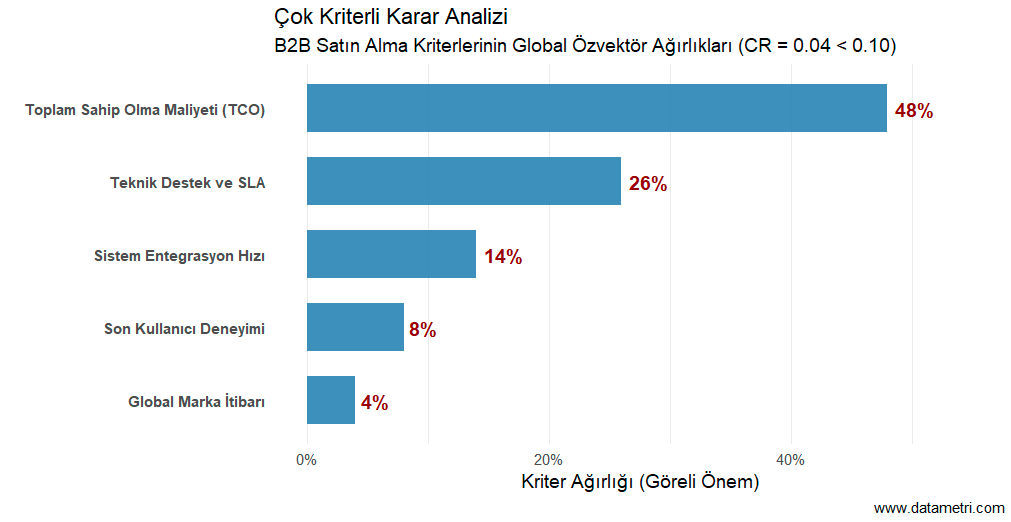
When consumers are asked how important a feature is, they generally give high scores to all features. Key Driver Analysis (KDA) ignores this misleading importance stated by the consumer (Stated Importance); it calculates the extent to which sub-feature performances trigger "overall satisfaction" or "purchasing intent" via statistical regression (Derived Importance). To resolve multicollinearity among variables, we use Shapley Value Regression, which is based on Game Theory. Thus, we decompose the model's total explanatory power (R²) according to the net and pure contribution of each feature to the final decision.
Which Questions Does This Analysis Answer?
- What are the structural differences between the factors consumers claim are "important to me" and the factors that "actually" drive their purchasing decisions?
- Into which 1-2 specific features should we invest our limited marketing and R&D budget to most rapidly drive market share?
What Could Be the Added Value to Your Business?
- Budget Optimization: Saves managers from investing in consumers' false statements, enabling them to focus on the features that will mathematically increase market share the most, thereby maximizing Return on Investment (ROI).
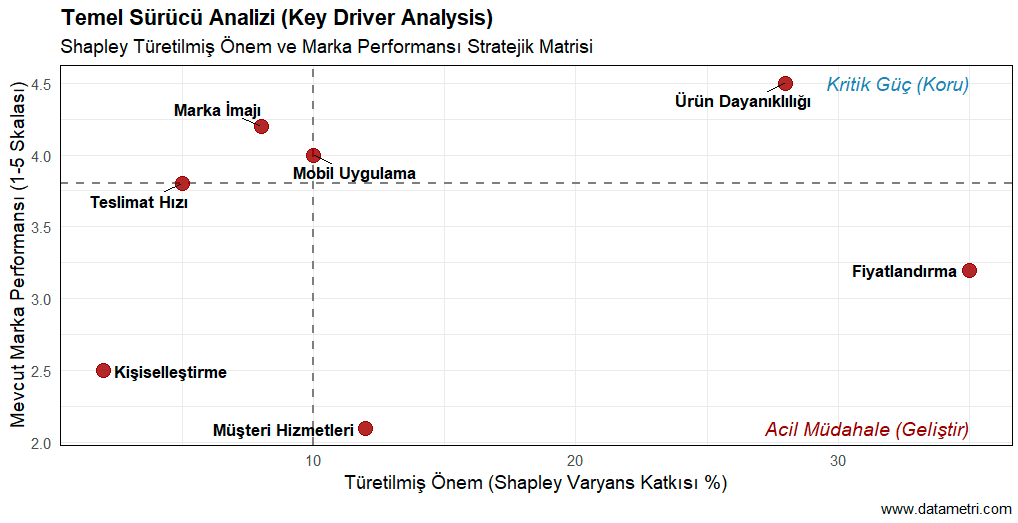
The Importance-Performance Quadrant Matrix in the visual contrasts "Derived Importance", calculated via the Shapley algorithm, with the brand's "Current Performance" in a two-dimensional space. The "Urgent Action" zone in the lower right corner (areas where the mathematical impact on the decision is very high but the brand's performance is low) definitively marks the primary investment targets to which management must allocate budget.